A very warm hello!
To protect IT infrastructures, it is important to take proactive security measures. The "blue and red teaming" represents a systematic approach to both strengthen the defense capabilities of companies against attacks and to identify and resolve potential vulnerabilities at an early stage.
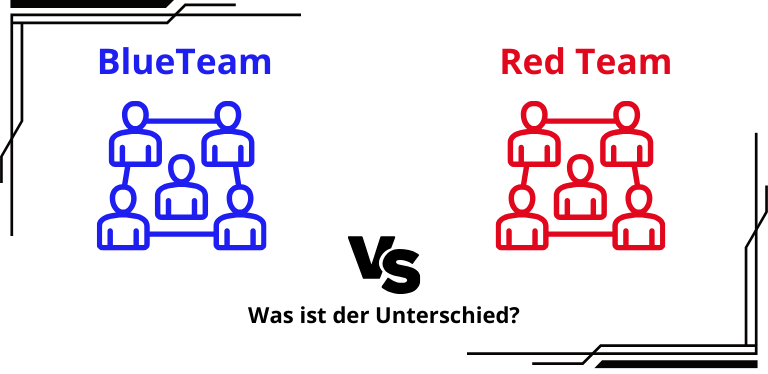
Put simply, two teams are formed – one red and one blue. The red team simulates an attack on the network while the blue team tries to fend off the attack.
We would like to discuss the exact differences below:
What is Red Teaming?
The Red Team is the "attack side" in a company’s security strategy. The aim of the team is to simulate cyberattacks in order to detect vulnerabilities in networks, systems and applications. These attacks assess a company’s security practices not by theoretical factors, as is the case when using security tools and systems, but by their actual performance in the face of real threats.
The team acts like a real attacker: It uses various techniques to bypass security measures to gain access to sensitive data or compromise systems. These include, for example, penetration tests, phishing campaigns or physical attacks. Each of these techniques provides valuable insights that show how a real attacker could proceed. In addition, they clarify the security gaps that exist in the IT architecture.
Red teaming is essential to reliably assess a company’s prevention, detection and correction mechanisms and maturity.
What is Blue Teaming?
While the Red team goes on the offensive, the Blue team on the defensive. The team consists of security experts who are responsible for detecting, deterring and preventing attacks. Their work is both proactive and reactive – protecting the IT infrastructure and developing strategies to minimize the company’s attack surface.
One of the tasks of the Blue team, for example, is to monitor networks and systems in relation to suspicious activity. This allows potential security incidents and vulnerabilities to be identified and analysed. In addition, surveillance also provides the basis for rapid backlash against attacks.
Another important task is creating security policies. These ensure that all employees, both existing and future, know the existing processes and rules and can follow them in the best possible way. The knowledge gained must be passed on internally for prevention, which is why training is a very important part of risk mitigation alongside safety guidelines. The latter create a security awareness that prevents social engineering attacks, because the human weakness in IT security, which usually results from ignorance, is one of the biggest risk factors.
Together, blue and red teaming provide a comprehensive approach to improving cybersecurity. They promote a better understanding of the threat landscape and help organizations take proactive measures to protect systems.
Once both teams have completed your tests, it is important to discuss all the results together and work out a plan to increase the company’s protection and eliminate any vulnerabilities that have been revealed.
Conclusion
Blue and Red Teaming are more than just modern security approaches – they are considered essential to survive in an ever-changing threat landscape. Companies implementing these strategies invest not only in their cybersecurity, but also in their trust with customers and partners. Only by combining attack simulation and strengthening defense can companies ensure that all systems and data are optimally protected and the risk of a hacker attack is reduced to a minimum.